
Should You Price Your Online Community Low? We Tried It and Almost Failed.
In our last article, we walked through how we built Morphios Lab from zero. We promised we'd pull back the curtain on Legal English Academy next, the community Ted and I actually built to a working business before Morphios Lab existed. This is that article. No theory, just the real numbers and the mistakes behind them.
We priced our lawyer-focused English community at $25 a month because we assumed a low price would attract more members. It didn't. Our cost per lead was around $100, so every signup at $25 lost us money unless they stayed in the community for at least 4 months. We raised the price four times over one year, up to $125 a month, and sales increased instead of dropping. Neither of us had a marketing background or had ever sold anything online before this.
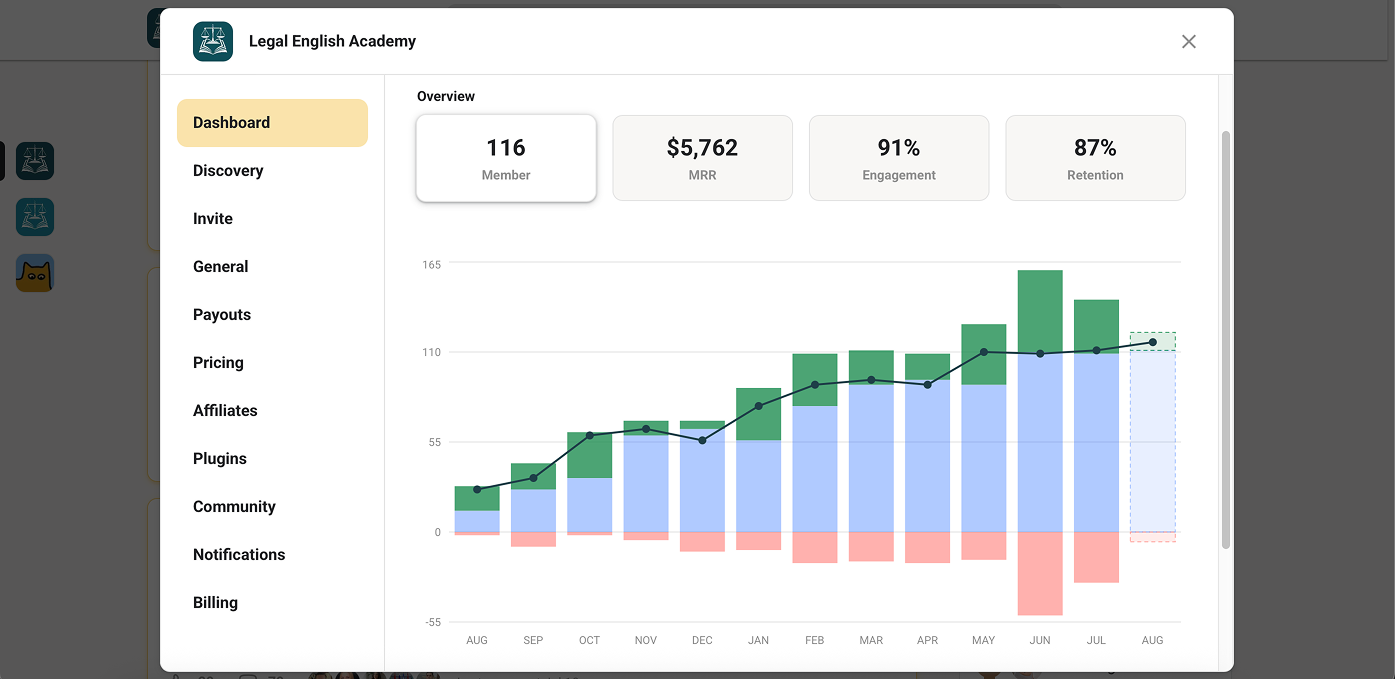
An image showing a software dashboard snippet embedded inside a content management system website editor, titled "Legal English Academy". The analytics dashboard displays business metrics for an online membership community, showing 116 members, $5,762 MRR (Monthly Recurring Revenue), 91% engagement, and 87% retention. Below the metrics, a stacked bar chart and trend line track growth and churn across months from August to August.
Who we are and why this matters
Mariia and Ted co-founded Legal English Academy, a Skool-based community that helps non-native English speaking lawyers improve their professional English. Neither of us had a background in marketing, online sales, or building a membership business. We hadn't taken a course on any of this. We learned by doing, and by making expensive mistakes along the way. One year in, the community has paying members across 30+ countries and consistent monthly recurring revenue closing in on 6k MRR as of mid-August 2026.
We're sharing the exact numbers and decisions below, including the ones we got wrong, because most advice about pricing an online community is theoretical. Ours isn't.
Does a lower price attract more members?
Not necessarily, and in our case, it actively hurt us.
We launched at $25 a month, assuming a lower barrier to entry would bring in more signups. Instead, we ran into a business problem that had nothing to do with how many people wanted to join: our cost per lead through paid ads was roughly $100. At a $25 monthly price, we were losing money on nearly every new member before they'd even stayed a full quarter. The math simply didn't work.
Some members told us later they assumed the course was a scam, because the price felt too low for what we were offering. Low pricing didn't just hurt our margins. It quietly hurt our credibility.
How much should a niche membership community cost?
Enough to cover what it actually costs you to acquire a member, plus room to prove your value.
We raised our price three times over the year: from $25 to $45, then to $75, and finally to $125 a month in April 2026. At $45 and $75, we were closer to breakeven but still not comfortably profitable given our ~$100 cost per lead. It wasn't until $125 that the business math actually made sense.
Here's the full pricing timeline:
Launch: $25/month, below cost per lead (~$100); several members assumed it was a scam +3 months: $45/month, closer to breakeven, still tight +6 months later: $75/month, improved margin, still not sustainable long-term April 2026: $125/month, sales increased, not decreased
At every price increase, we expected sign-ups to drop. They didn't. What we were actually selling wasn't "cheap English lessons." It was a specific, hard-to-find solution for a niche audience: lawyers who needed professional English for real legal work, not general language practice. Once the price reflected that, people stopped comparing us to generic English courses and started evaluating us as a legal training investment. FYI in a few weeks, starting September 1st, we will increase the price again and only offer annual memberships.
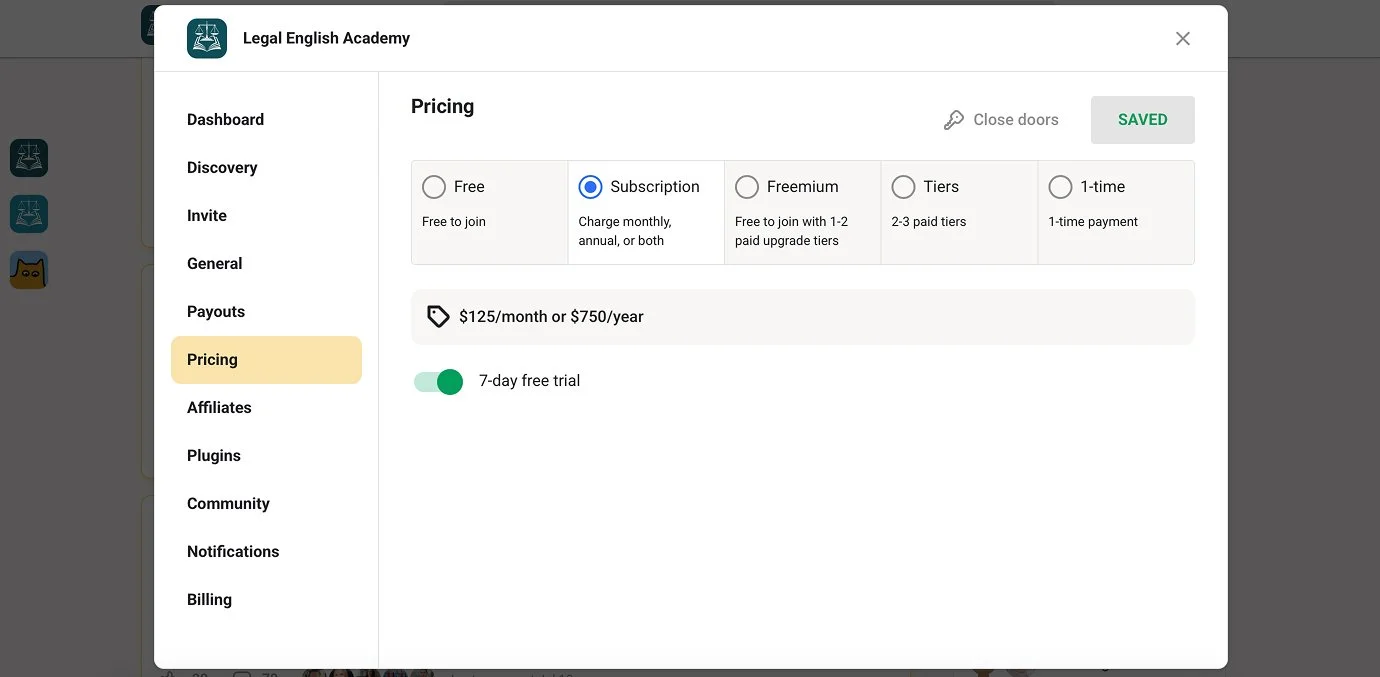
A screenshot of an online community management platform's pricing configuration dashboard for "Legal English Academy". The interface shows five pricing model options: Free, Subscription, Freemium, Tiers, and 1-time. The "Subscription" option is selected, showing a configured rate of $125 per month or $750 per year, with a active 7-day free trial toggle switched on.
What happens when you raise your community's price?
If your product solves a specific, high-stakes problem for a well-defined audience, raising the price can increase trust rather than reduce demand.
We didn't expect this. Our assumption going in was that price and demand move in opposite directions, in a straight line. That held true right up until we had a genuinely specific offer for a genuinely specific audience. At that point, price stopped being the main objection, and specificity became the main selling point.
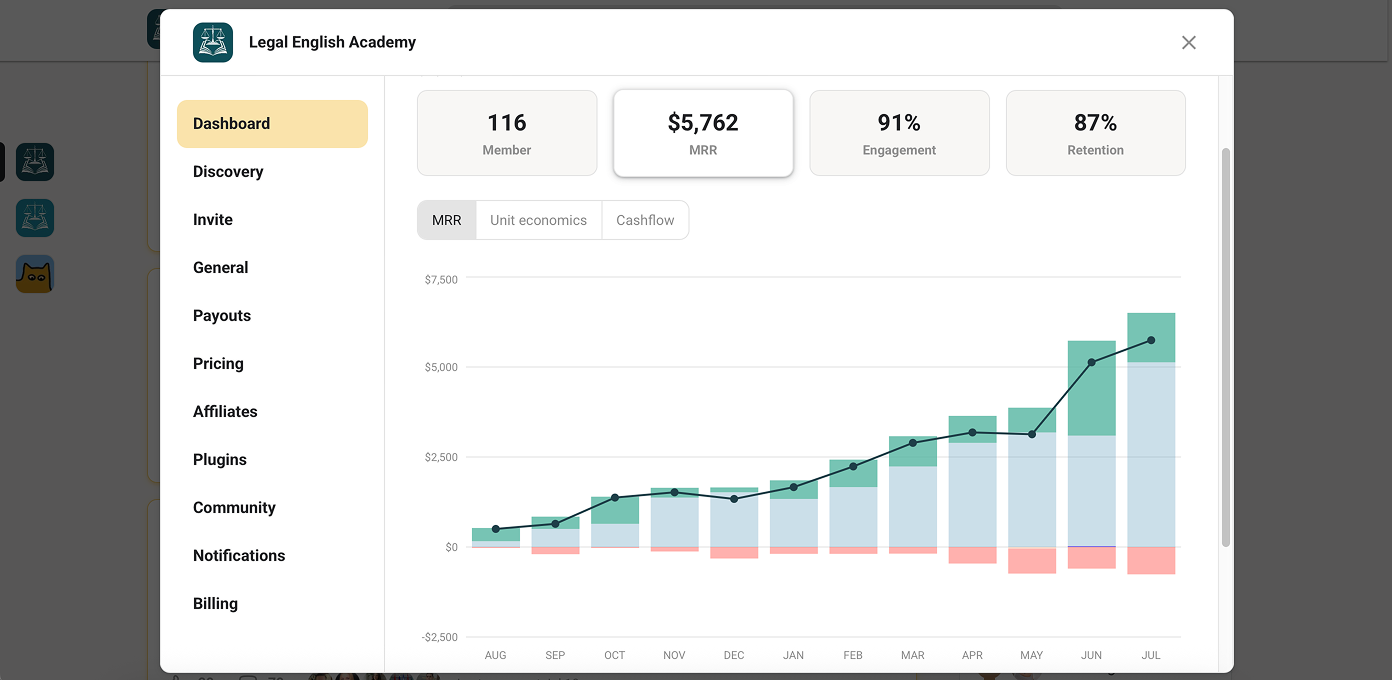
A software dashboard screenshot for "Legal English Academy" showing a detailed view of its "MRR" (Monthly Recurring Revenue) growth analytics graph. The interface highlights core metrics of 116 members, $5,762 MRR, 91% engagement, and 87% retention. Below these stats, a segmented bar chart with an overlaying trend line plots financial progression, showing a steady upward climb in total revenue from August through July.
Was WordPress the right platform for an online community?
For us, no, but the decision wasn't obvious at the time, and it's worth understanding why we chose it in the first place.
Ted was convinced WordPress was the right call before we launched. His reasoning wasn't unfounded: WordPress powers over 40% of all websites on the internet, more than any other platform by a wide margin. To him, that made it the safe, proven choice. Mariia disagreed and wanted to build the site from scratch with a hired developer instead (which would have been significantly more expensive than Wordpress). We went back and forth on this as co-founders before settling on WordPress.
In practice, WordPress meant stacking plugin after plugin: one for payments, one for memberships, one for course content, and Amelia, a booking plugin, to let students actually book their lessons. Each plugin had its own monthly fee and its own risk of breaking on update. Because payments ran through our own site, we were also responsible for storing and protecting members' payment data ourselves, a real security obligation for a two-person team.
We eventually moved to Skool, a platform that handles community, courses, payments, and events in one place, with Skool itself acting as the third party processing payments, not us. We found it almost by accident, through a creator we happened to be following. Our first reaction wasn't excitement. Their site showed us an about page and nothing else. We couldn't see what was actually inside the platform, and the price didn't help: at the time, Skool only offered one plan, at $99 a month. For two people who hadn't launched anything yet, that felt like a real risk.
Before committing, we spent time watching other people's videos about how communities were actually structured inside Skool. That's what turned the decision from a guess into something we could evaluate honestly.
What we'd tell someone starting from zero
We didn't have a marketing background. We didn't have online sales experience. We didn't take a course on any of this before starting. Everything in this article, pricing, platform choice, positioning, we figured out by doing it wrong first and adjusting.
Two things did move the needle once we got serious about growth: paid advertising, once we understood our cost per lead well enough to price against it, and starting a YouTube channel to document the process publicly. Both took us longer to commit to than they should have. Neither required a marketing degree. They required deciding to start before we felt ready.
If there's one regret bigger than any pricing mistake or platform decision, it's not something we did wrong. It's the ten years before this when the idea existed and we didn't act on it. Ted had been fielding the same English-language questions from legal colleagues for years before we ever considered turning it into a community. The problem was always there. We just didn't start building the solution until much later than we could have.
What's improved most because of this isn't something you'd see in a revenue chart. Ted teaches the live sessions every week, working directly with senior legal professionals from all over the world. It's genuinely rewarding work, the kind that made a bigger difference to how he experiences his day-to-day than the numbers did.
If you're sitting on a skill, a hobby, or a piece of knowledge that people already come to you for, that's usually the signal. You don't need the marketing background first. You need to start before you feel ready, the same way we did.
Prefer to watch the story? Here's the full video
Join Morphios Lab
We're building Morphios Lab completely in public, starting from zero.
If you want to be one of the first members, now is the time to join. There isn't a polished course or a finished business waiting for you. We're building the community, testing ideas, and figuring out what works alongside the people who join.
You'll get to see the process as it happens, participate in the early community, and help shape what Morphios Lab becomes.
Want to Build Your Own Community?
You don't need a perfect idea, a large audience, or years of experience to start building an online community.
A skill, profession, hobby, or area of expertise can be enough.
If you want to create your own Skool community, you can use the same process we walked through in this guide.
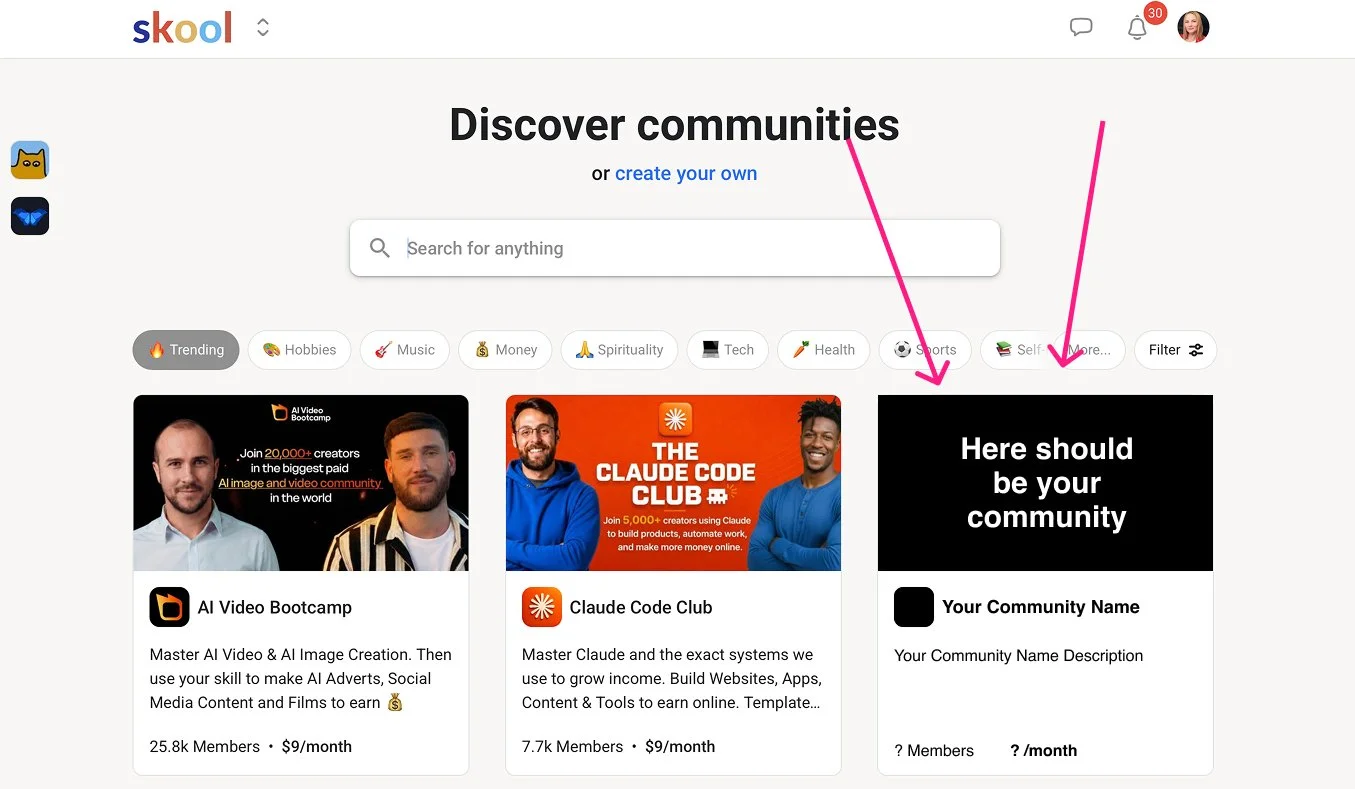
Skool Discover communities directory page layout featuring trending groups with pink arrows pointing to a custom mockup card that reads Here should be your community.
Frequently Asked Questions
Does a lower price attract more members to an online community?
Not necessarily. We launched at $25/month expecting it to bring in more signups, but our cost per lead was around $100, so we lost money on nearly every new member. Some members even assumed the low price meant the course was a scam.
How much should you charge for a niche membership community?
Enough to cover your actual cost per lead, plus room to prove your value. We raised our price four times over one year, from $25 to $125 a month, and it wasn't until $125 that the business math made sense.
Does raising your price reduce demand?
Not always. If your product solves a specific, high-stakes problem for a well-defined audience, raising the price can increase trust rather than reduce it. Our sales grew, not shrank, with every price increase.
Is WordPress a good platform for building an online community?
It depends on what you're building. WordPress powers over 40% of all websites on the internet, more than any other platform, which is why we initially chose it. In practice, we ended up managing a stack of separate plugins for payments, memberships, courses, and scheduling, each with its own fee and its own risk of breaking.
Do you need a marketing background to build a profitable online community?
No. Neither of us had a marketing background or had sold anything online before starting Legal English Academy. We learned pricing, positioning, and platform decisions by getting them wrong first and adjusting.
What's the biggest mistake people make when pricing a new community?
Assuming a lower price automatically means more signups and more revenue. Price needs to cover what it actually costs you to acquire a member, not just what feels approachable to a new customer.
What's Next
This is the second article in our build-in-public series. Up next, we're covering the rest of what we learned in Legal English Academy's first year: how we went from advertising in Costa Rica only to members in 30+ countries, why we launched before the platform was anywhere close to ready, and what we're testing right now to fix our weakest metric, converting About page visitors into trial members.
Mariia co-founded Legal English Academy, a Skool-based community for legal professionals, alongside Ted, a native English-speaking lawyer and notary based in Costa Rica. She documents the process of building niche online communities at Morphios Lab.
Key Takeaways
A lower price doesn't automatically mean more members. If your price is below what it actually costs you to acquire a customer, you lose money on every signup, no matter how many people join.
Price against your real cost per lead, not against what feels approachable. We didn't break even until our price matched our ~$100 cost per lead.
Raising the price can increase trust, not just revenue, when your product solves a specific problem for a specific audience.
The platform you choose shapes your workload for years. WordPress plugins meant more maintenance, more fees, and more security responsibility than an all-in-one platform.
You don't need a marketing background to build a profitable community. We learned pricing, positioning, and platform decisions by getting them wrong first.
